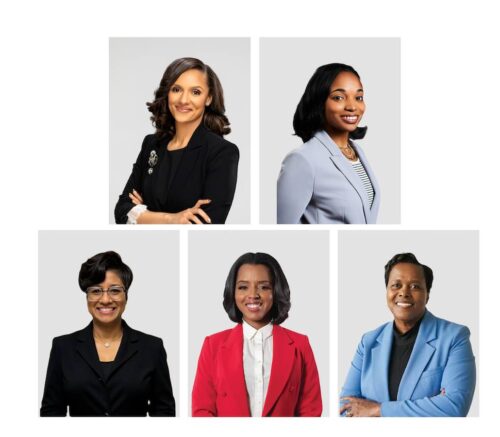
In Albany, New York’s capital city, mayor-elect Dorcey Applyrs stood before a packed room at a downtown nightclub as Jay-Z’s “Run This Town” blared through the speakers. “This is our moment,” she told supporters, promising to be the kind of mayor who makes sure “every young person in this city knows that they belong, that they have a seat at the table.”
In Detroit, voters chose Mary Sheffield — a city council president who describes herself as a “daughter of Detroit” — to become the city’s first woman and first Black woman mayor. In Kansas City, Kansas, Christal Watson broke a 30-year political grip to become the first Black woman elected mayor and CEO of the Unified Government of Wyandotte County.
From big cities like Detroit and Syracuse to small communities like Media, Pennsylvania, the November 2025 elections produced a wave of Black women mayors — victories that were both intensely local and firmly rooted in national debates about race, democracy and economic power.
A wave of firsts
The 2025 off-year elections were dominated in national headlines by the Democratic sweep in gubernatorial and big-city races. But beneath those marquee contests, Black women quietly redrew the political map at the local level.
Mary Sheffield was elected mayor of Detroit, becoming both the first woman and the first Black woman to lead the city. A 38-year-old city council president and longtime housing advocate, her victory capped a decade-long rise from the council’s youngest member to the city’s top job.
Dorcey Applyrs was chosen as the first Black mayor in the 300-plus-year history of Albany, New York, after handily defeating a Republican challenger in a heavily Democratic city.
Christal Watson became the first Black woman to lead the Unified Government of Wyandotte County/Kansas City, Kansas, winning a hard-fought race defined by concerns over housing, infrastructure and government transparency.
Joi Washington, an illustrator and borough council member, was elected mayor of Media, Pennsylvania— a town where just about three percent of residents are Black — becoming both the first woman and the first person of color to hold the office.
Sharon Owens, a longtime city administrator and deputy mayor, won the mayor’s race in Syracuse, New York, and will serve as the city’s first Black mayor, running on an “Inclusive & Growing Economy” plan centered on neighborhood small businesses and housing.
Their wins come at a moment when Black women’s representation is reaching record highs but still lags far behind their share of the U.S. population. A July 2025 report by Higher Heights and the Center for American Women and Politics found that while Black women have made “historic progress” across state and local offices over the past decade, they remain underrepresented at nearly every level of government — and that gains are uneven, with many regions still badly behind.
The women elected this November are part of that slow-building wave. Their campaigns were not simply about shattering glass ceilings. They were about governing — about property taxes and water bills, bus routes and crumbling sidewalks, school funding and small-business capital — the daily concerns of residents who are often on the losing end of America’s racial wealth and banking gaps.
Detroit: A “daughter of Detroit” takes the helm
Mary Sheffield’s campaign was built around a deceptively simple promise: to make Detroit’s “comeback” feel real in neighborhoods that had seen more tax foreclosures and shut-off notices than ribbon-cuttings.
Sheffield is the daughter of a nurse and civil rights activist Horace Sheffield III, and she has long framed her politics as an extension of that legacy. First elected to city council in 2013 at age 26, she quickly became known for pushing inclusionary housing policies, property tax reform, and a neighborhood beautification program — work that drew the attention and endorsement of Higher Heights, the Black women’s political organization.
In a pre-election interview with Detroit’s WXYZ, Sheffield was blunt about what shaped her agenda. Growing up in a city marked by plant closures, mass foreclosures and water shut-offs, she said, taught her that “when systems don’t work for the people, you change them.”
Expand affordable housing and strengthen protections for renters.
Reform Detroit’s property tax system, which has long been criticized for over-assessing homes in Black neighborhoods and feeding tax foreclosures.
Those issues are impossible to separate from Detroiters’ experiences with banks and credit. Over the past decade, the city has been ground zero for national debates over predatory lending, mortgage denials and the role of big banks in urban disinvestment. Nationally, Black families hold about one-sixth the median wealth of white families — roughly $44,100 versus $284,310 — and remain far less likely to own homes.
Recent analyses of U.S. mortgage lending show Black applicants are still more than twice as likely to be denied a home loan as white borrowers with similar profiles. For Detroit residents who already endured the foreclosure wave of the 2000s and 2010s, those numbers aren’t abstract. They’re the backdrop for every promise Sheffield made about affordable housing, stricter oversight of development deals, and neighborhood-level investment.
Her victory gives those promises a mandate — and places a Black woman who grew up in the city’s working-class households at the center of decisions that will determine who gets to stay in Detroit and on what terms.
Albany: The auditor who promised inclusion
If Detroit’s race was a clash of visions for a city still emerging from bankruptcy, Albany’s was about who would define a quieter, but no less consequential, transition.
Dorcey Applyrs arrived at City Hall not as a charismatic outsider but as a technocrat with a doctorate in public health and years spent on the council and as chief city auditor. As auditor, she led a widely noted review of the city’s “Equity Agenda,” praising progress but bluntly identifying dozens of ways in which city policies were still falling short for marginalized communities.
When she launched her mayoral bid, Applyrs leaned into that reputation for scrutiny. Her campaign’s “First Term Action Plan” promised:
A data-driven approach to public safety, including internships and mentorships to draw local youth into policing careers and an emphasis on addressing the root causes of crime.
Investments in affordable housing and safer streets as preconditions for economic development.
A more rigorous equity lens on city spending and contracts.
On election night, she took the stage as the first Black person ever elected mayor of Albany — a city with deep racial disparities in income, housing and exposure to environmental harms. Her win was decisive: more than 11,000 votes to her opponent’s fewer than 2,000.
Applyrs has frequently talked about wanting young people “to know they belong, that they have a seat at the table, and that they can build a future right here.” In a city where Black residents are more likely to live in neighborhoods with higher pollution, lower homeownership and more precarious employment, that future will depend in no small part on how she steers municipal borrowing, housing policy and small-business support — in other words, how local government interacts with the banking and credit systems that have long bypassed or exploited her constituents.
Kansas City, Kansas: Faith, austerity and a low-turnout upset
Christal Watson’s victory in Kansas City, Kansas, was narrower and more fragile than the celebrations suggested.
The mayoral race unfolded amid voter fatigue and skepticism toward a political establishment that many residents felt had delivered more tax incentives for developers than relief for longtime homeowners and renters. Turnout hovered under 20 percent. Watson — a former deputy chief of staff in the Unified Government and current head of the KCK School Foundation for Excellence — ran a lean campaign without major endorsements or big-money backing.
“We didn’t have the money. We didn’t have the status quo for public support,” she told Kansas City’s KSHB 41 in an extended post-election interview. She described her decision to run as a “divine calling,” saying her faith sustained her through a race in which she was often outspent and out-organized.
Watson has staked out a platform that blends managerial reform with neighborhood-level concerns:
Cleaning up City Hall by making budgets more legible and accessible to residents.
Prioritizing infrastructure projects in overlooked neighborhoods rather than concentrating development downtown.
Supporting small businesses and workforce programs as tools to keep young people in Wyandotte County.
Those priorities reflect the daily financial realities of a county where many residents are renters, where generational wealth is rare, and where banks and credit unions aren’t evenly distributed across neighborhoods. National FDIC data show that Black households remain far more likely to be “unbanked” or “underbanked” — relying on check-cashers, payday lenders or pawn shops even when they have a bank account — than white households.
Watson’s challenge will be translating her message of faith and fairness into concrete changes in how the Unified Government taxes, spends and borrows — decisions that determine whether working-class residents feel like customers with real power in the financial system, or like people perpetually on its margins.
Media, Pennsylvania: Representation in a 3-percent-Black town
If Detroit and Albany symbolized big-city change, Media, Pennsylvania, was a reminder that transformative wins can happen in small places.
Media is a postcard-sized borough outside Philadelphia with a population that is overwhelmingly white and only about three percent Black. For years, local politics were dominated by familiar names and a familiar demographic profile.
Joi Washington changed that.
A borough council member and illustrator, Washington spent years in community work before mounting a mayoral bid. Local coverage described her campaign as focused on:
Walkability and transit, including safer streets and better connections to regional rail.
Support for small, locally owned businesses in the downtown core.
Making Media’s growth more inclusive, ensuring new development doesn’t price out longtime residents.
In November, voters elected her the town’s first woman mayor and first mayor of color.
Her win echoes a broader pattern that Black political reporters and organizers have been tracking: quiet sweeps by Black women in local offices that rarely attract national attention but cumulatively reshape who oversees school budgets, zoning boards and municipal contracts.
In communities like Media, those offices control the levers that matter for residents who are trying to get a first mortgage, keep a storefront afloat or simply pay rising utility bills. Washington ran explicitly on the idea that local government can be an ally rather than an adversary in those daily negotiations with lenders, landlords and service providers.
Syracuse: An “Inclusive & Growing Economy”
In Syracuse, New York, Sharon Owens stepped into the mayor’s race not as a newcomer but as the city’s deputy mayor — someone who had spent years navigating the fine print of city budgets and economic development plans.
Owens’ campaign was built around an economic blueprint she called the “Inclusive & Growing Economy” plan. Among its highlights:
Strengthening neighborhood business corridors and expanding support for small, especially Black- and brown-owned, businesses.
Ensuring that tax incentives and development deals deliver concrete benefits — jobs, amenities, affordable units — for city residents, not just investors.
Expanding entrepreneurship support for BIPOC and immigrant communities.
Aligning workforce training with local jobs and removing barriers like child care and transportation that keep people out of the labor market.
Local media and university outlets reported that when Owens won in November, she became Syracuse’s first Black mayor and one of the few Black women to lead a major upstate city.
Her policy slate reads like a point-by-point response to the financial bottlenecks that define life in many majority-Black neighborhoods: difficulty getting startup capital, predatory small-business loans, and a mismatch between the training programs on offer and the jobs that actually exist.
Those bottlenecks are linked to what national fair-housing and consumer-protection advocates describe as a two-tier system of finance. Even as the overall share of unbanked households has fallen to 4.2 percent nationwide, more than 14 percent of U.S. households are considered “underbanked” — and Black households are disproportionately represented in both groups.
Owens’ pledge to “digitize permits,” streamline approvals and reform tax incentives may sound technocratic. But for the small manufacturers, childcare providers and corner-store owners who make up her base — many of whom toggle between mainstream banks and alternative lenders — those changes could determine whether they survive the next recession.
Banking, race and the politics of everyday money
Threaded through each of these women’s campaigns is a recognition that the most powerful forces shaping their constituents’ lives are often not in City Hall at all, but in bank headquarters, credit algorithms and mortgage underwriting standards.
The numbers are stark:
Median white household wealth is more than six times that of median Black households.
Black borrowers are still far more likely than white borrowers to be denied mortgage loans, even after accounting for income and other factors.
Roughly a third of unbanked U.S. households are Black, and Black households remain significantly more likely to rely on check-cashers, money orders and payday lenders to meet basic financial needs.
These statistics translate directly into the stories residents told on the campaign trail: the Detroit homeowner fighting an inflated property tax assessment; the Albany family juggling rent, medical debt and predatory credit-card offers; the Wyandotte County small-business owner denied a bank loan and pushed toward high-interest online credit.
While comprehensive personal narratives about each mayor-elect’s own experiences as bank customers are not widely documented in public reporting, their platforms are steeped in the financial pressures of the communities they come from and now serve. Sheffield’s focus on property tax fairness and affordable housing, Applyrs’ emphasis on equity-minded budgeting, Watson’s push for transparent public finances, Washington’s defense of small Main Street businesses, Owens’ insistence on inclusive entrepreneurship — all are attempts to give ordinary people more leverage in a financial system where the odds are not evenly stacked.
That work is unfolding against a volatile national backdrop. Analysesof the “economic state of Black America” in early 2025 point to modest gains in income and employment but persistent gaps in wealth, homeownership and access to credit. At the same time, civil-rights groups are warning that federal rollbacks of “disparate impact” standards — the legal tools used to challenge discriminatory lending and housing practices — are making it harder to hold financial institutions accountable.
In that context, the levers of municipal power that these Black women now control — zoning rules, development incentives, public banking partnerships, local fair-housing enforcement — take on outsized importance. They can’t single-handedly close the racial wealth gap or eliminate discriminatory lending, but they can decide whether public dollars reinforce those patterns or begin to unwind them.
Beyond symbolism
For decades, Black women activists and scholars have argued that representation without resources is not enough. The new mayors elected in November 2025 seem acutely aware of that.
Mary Sheffield has already hinted at using the mayor’s office to push institutions — from banks to developers — toward “people-centered” metrics of success.) Dorcey Applyrs has framed her audit-driven approach as a way to ensure that lofty equity commitments translate into line-items in the budget, not just press releases. Christal Watson talks as much about open data and accessible budgets as she does about roads and parks, signaling that for her, transparency is a form of economic justice.
Their wins also complicate easy narratives about where Black political power lives. It’s not confined to deep-blue coastal metros or majority-Black cities. It’s in upstate capitals and small Pennsylvania boroughs, in Midwestern counties and Rust Belt neighborhoods where bank branches have vanished but the memory of discriminatory lending remains vivid.
The Higher Heights/CAWP report on Black women in American politics argues that every such victory is part of a longer arc that stretches back to Shirley Chisholm and forward through Kamala Harris and a rising generation of lawmakers. The women elected this November are writing a new chapter in that story — one that is less about national spectacle and more about the granular power to decide who gets a loan, whose street gets plowed, whose water stays on.
Their constituents will not judge them by the history books. They will judge them by whether the bank finally approves a fair mortgage, whether an overdue utility bill leads to a shutoff notice or a payment plan, whether a young person can imagine a future in their hometown.
For now, on the heels of a historic election night, Black women in cities large and small have something they have long demanded but too rarely received: the authority to make those decisions — and the chance to show what governance looks like when it is shaped by the people who have most often been left outside the vault.